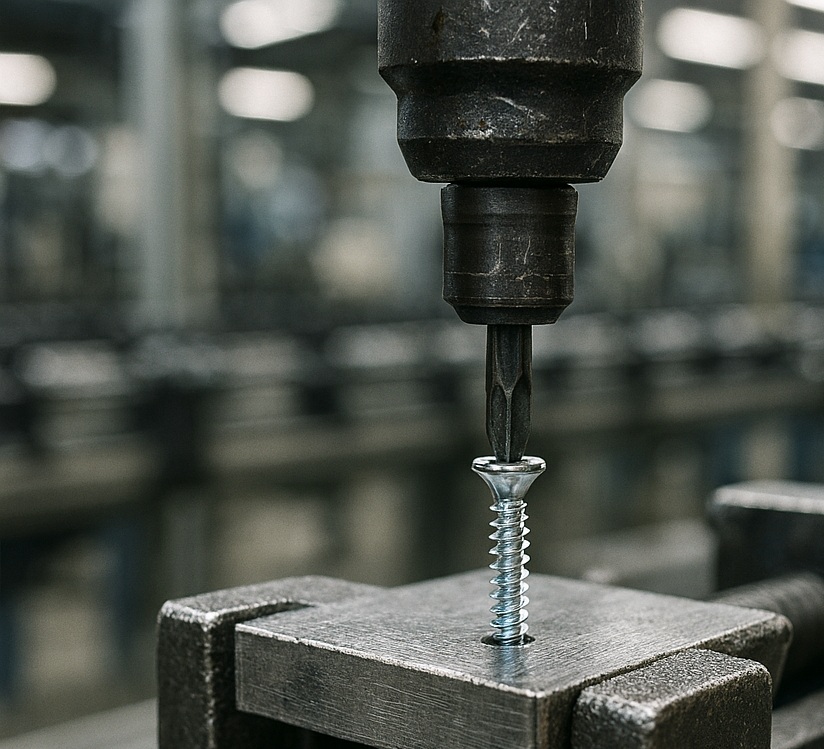
The tightening torque of metric screws is the torque applied to generate the correct preload in the screw, with the aim of ensuring stability and safety of the joint.
Correct tightening prevents breakage, loosening, and loss of performance of the assembly.
Why is tightening torque fundamental?
Tightening torque is the rotational force applied to a screw to obtain controlled preload.
The purpose of this action is not the most obvious one of “locking” the parts together, but rather to elastically tension the screw. In practice, the screw becomes a real spring that keeps the components together.
In fact, according to our experience at Viteria Fusani, manufacturing screws since 1955, most problems in bolted joints do not originate from the screw itself, but from incorrect tightening.
Correct screw tightening is able to provide long-term stability, resistance to vibrations and dynamic loads, structural safety, and extended component life.
The 3 factors that influence tightening torque
More than 85–90% of the applied tightening torque is absorbed by friction. For this reason, Viteria Fusani recommends always considering these three fundamental factors:
- Lubrication
A lubricated screw reduces friction and increases preload for the same torque value. Applying a “dry” torque value to a lubricated screw can lead to overload and breakage. - Surface coating
Zinc plating, black oxide treatment, special treatments, or anti-friction coatings significantly modify friction. - Material of the screw and the clamped components
Strength class, elastic modulus, and hardness influence load distribution and the elastic response of the joint.
Why a screw breaks if tightened too much
Excessive tightening pushes the screw beyond its elastic limit. This action triggers crack initiation or permanent deformation, and the preload does not increase further.
Typical consequences of excessive tightening are immediate breakage of the element, delayed failure after load application, or subsequent fatigue failure.
Therefore, most of the time the screw is not defective: it has simply been tightened beyond the correctvalue.
Why a screw loosens if tightened too little
On the other hand, insufficient preload in screw tightening does not ensure complete adhesion between the surfaces.
In fact, when preload is insufficient, micro-movements occur, progressive loss of tension develops, and spontaneous separation of the surfaces begins.
In the presence of vibrations or alternating loads, the screw loosens even if it initially “seems tight”.
Tightening torques
It is not possible to create a universal table for tightening torques, as these values may vary significantly depending on several factors, such as lubrication, surface treatments, strength class, screw geometry, and assembly conditions.
To determine the correct values, it is recommended to refer to the applicable technical standards (e.g. ISO 898-7 for breaking torques).
Technical note
Correct tightening always comes from the combination of calculation, experience, and real application.
However, there are factors that must be considered:
- In the presence of lubrication or low-friction coatings, the torque may be reduced by up to 40%.
- For 12.9 screws, tightening control is even more critical: there is a high risk of breakage due to overload.
- The use of thread lockers or polyamide patches modifies the behavior of the thread.
Mechanical and chemical locking systems to maintain tightening over time
Correct tightening does not depend only on the applied torque. In many applications it is necessary to act on the behavior of the thread.
Other solutions to ensure proper tightening include:
- Polyamide inserts (nylon patch)
Inserted directly on the thread, they increase friction and prevent loosening without damaging the joint. - Chemical thread lockers
Anaerobic resins that polymerize in the absence of air, ideal for applications subject to vibrations. - Safety washers
Spring, toothed, or wedge-lock washers contribute to tightening stability. - Self-locking nuts
They incorporate elastic elements or controlled deformation to maintain preload.
Tightening torque: not only numbers, but knowledge
Tables are useful tools, but they do not replace the analysis of the real application.
Correct tightening comes from the combination of theoretical calculation, practical experience, and knowledge of materials.
Understanding what the tightening torque of metric screws is and evaluating all its critical aspects means preventing failures, increasing safety, and improving the durability of assemblies.
This is precisely the approach that has always distinguished Viteria Fusani, screw manufacturer since 1955, in supplying reliable fastening solutions.