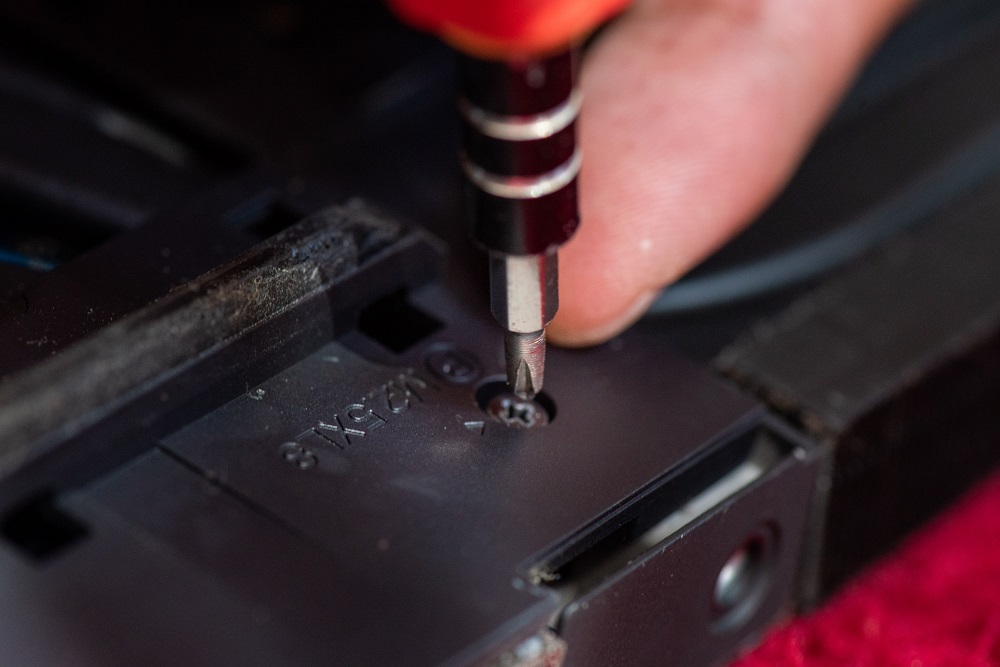
In several cases of tightening problems reported by customers of Viteria Fusani, the issues were not related to the screw itself, but to incorrect settings of the tightening parameters in automatic systems.
In particular, incorrect values were found applied to the tightening force or an excessive number ofturns. Both situations cause damage to the assembled parts or non-compliant tightening.
Specifically, these typical errors identified can be traced back to:
- A torque set without considering friction and coating
- Screwdriving speed that is too high
- Control based only on the number of turns, without checking the actual preload
- Absence of a controlled placing phase.
These errors are particularly frequent in high-productivity automatic lines.
The role of technical dialogue between customer and supplier
The resolution of the problem was achieved through direct discussion between customer and supplier. This took place through a complete and in-depth analysis of the screw used, the combined materials, the tightening parameters set, and the behavior of the joint during assembly.
By reasoning together about the correct machine setup, it was possible to redefine:
- tightening torque
- screwdriving speed
- number of turns
- tightening sequence.
The result
After this in-depth analysis it was possible to eliminate damage to components, achieve smoother and more repeatable assembly, and obtain correct tightening that remains stable over time.
This application-based approach, built on practical experience, is an integral part of the technical support offered by Viteria Fusani, manufacturer since 1955.
Technical Checklist for Automatic Screwdriving
(Correct tightening – stability – repeatability)
Screw control
Before intervening on machine parameters, it is essential to check the component.
✔ Correct thread (standard metric or special)
✔ Strength class (8.8 / 10.9 / 12.9)
✔ Compliant surface coating
✔ Presence of locking elements (polyamide patch, locking patch, etc.)
✔ Screw condition (absence of deformation or defects)
Technical note
A screw with a locking patch requires different screwdriving parameters compared to a standard screw.
Check of the combined materials
The tightening behavior also depends on the assembled parts.
✔ Base material (steel, aluminum, plastic, alloys)
✔ Presence of internal threads or inserts
✔ Clean contact surfaces free of contaminants
✔ Thickness and flatness of the components
Technical note
Deformable surfaces require more controlled torque and speed.
Setting the tightening torque
✔ Torque setting appropriate to:
• screw diameter
• strength class
• friction conditions.
✔ Verification whether tightening is:
• dry
• lubricated
• with special coatings.
✔ Use of correct values (tightening torque tables as an initial reference)
Technical note
Applying a “standard” torque to non-standard conditions is one of the main causes of failure.
Setting speed and number of turns
In automatic systems, torque alone does not make the difference.
✔ Screwdriving speed appropriate for the material
✔ Number of turns appropriate to the screw length
✔ Avoid excessive speeds that cause:
• overheating
• thread damage
• part deformation
Technical note
Direct experience of Viteria Fusani, manufacturer since 1955: an excessive number of turns is often the origin of apparently “unexplainable” damage.
Screwdriving sequence
✔ Controlled positioning phase
✔ Tightening phase separate from insertion
✔ Avoid direct torque impact
✔ Presence of a torque ramp-up phase (if available).
A correct sequence guarantees repeatability and assembly quality.
Check of the actual preload
✔ Verification that the applied torque generates the desired preload
✔ Sample tightening checks
✔ Monitoring of the first production cycles
✔ Analysis of any loosening over time.
Technical note
Remember: Tightening torque is simply the practical means of generating the requiredpreload.
Technical dialogue between customer and supplier
In case of anomalies:
✔ Sharing of screwdriving parameters
✔ Joint analysis of the assembly joint
✔ Evaluation of:
• alternative screw
• different coating
• integrated locking system
This collaborative approach is the basis of the solutions developed by Viteria Fusani, manufacturer since 1955, for correct and smooth assembly.
Final quick checklist (for the production department)
- Correct screw ✔
- Adequate torque ✔
- Controlled speed ✔
- Correct number of turns ✔
- Preload verified ✔