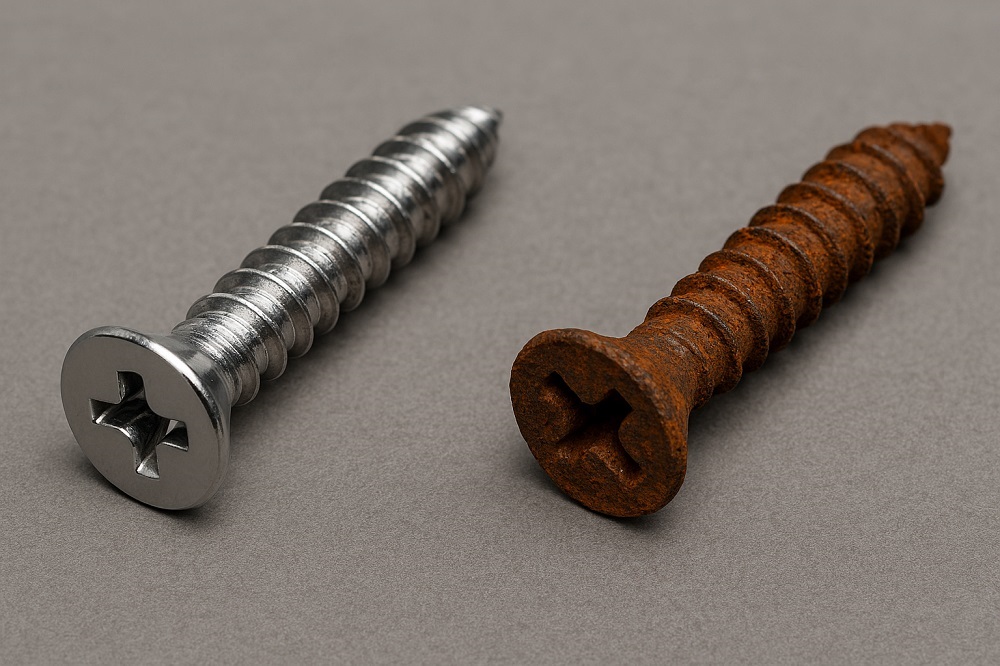
If you are looking for a stainless steel screw that offers good corrosion resistance, it is better to choose knowing the A2, A4 and F/430 classes.
For standard applications and in the presence of normal humidity, class A2 is sufficient.
For aggressive, marine, or chemical environments, A4 is the safest choice.
Classification of Screws According to ISO 3506
The mechanical and chemical requirements for stainless steel fasteners are defined by the ISO 3506 standard. This introduces a classification system with abbreviations based on:
- Steel family (metallurgical structure and presence of molybdenum)
- Mechanical strength class.
| ISO Code | Stainless Steel Type | AISI/EN Correlation | Notes |
| A2 | Austenitic without molybdenum | 304 / 1.4301 | Standard, good general corrosion resistance |
| A4 | Austenitic with molybdenum | 316 / 1.4401-1.4404 | Excellent resistance to chlorides and corrosive environments |
| F | Ferritic | 430 / 1.4016 | Limited corrosion resistance, magnetic |
Main Differences Between A2, A4 and 430 Stainless Steel
A2 (AISI 304 / EN 1.4301)
Austenitic stainless steel without molybdenum, containing chromium and nickel. It offers good corrosion resistance in standard environments and is suitable for indoor or general atmospheric applications.
A4 (AISI 316 / EN 1.4401-1.4404)
Austenitic stainless steel with molybdenum (≈2–3%), which improves resistance to chloride corrosion. It is recommended for aggressive, marine, or chemical environments.
F / 430 (AISI 430 / EN 1.4016)
Ferritic stainless steel without nickel, magnetic, with lower corrosion resistance compared to A2 and A4. It is suitable for mildly aggressive indoor environments or where cost is the main priority.
Strength Class
After the designation A2/A4/F, a number is always present. This indicates the minimum mechanical strength of the screw:
- 70 → 700 N/mm² (nominal tensile strength)
- 80 → 800 N/mm²
Examples:
- A2-70 → austenitic stainless steel type 304, minimum tensile strength 700 N/mm²
- A4-80 → austenitic stainless steel type 316, minimum tensile strength 800 N/mm²
Comparison Table of Stainless Steel Screw Classes
| Characteristic | A2 Steel (304) | A4 Steel (316) | F/430 Steel (430) |
| Chemical composition | Cr 18% – Ni 8% | Cr 16–18% – Ni 10–14% – Mo 2–3% | Cr 16–18% – Ni 0% |
| Metallurgical structure | Austenitic | Austenitic | Ferritic |
| Corrosion resistance | Good in indoor and atmospheric environments | Excellent in marine, chemical and chloride environments | Limited, suitable for mildly aggressive indoor environments |
| Magnetism | No (slightly magnetic after deformation) | No (slightly magnetic after deformation) | Yes |
| ISO 3506 class (screws) | A2 | A4 | F |
| Indicative price | Medium | High | Low |
| Typical applications | Construction, machinery, window frames | Marine, chemical, food industry | Indoor environments, decorative and economical applications |